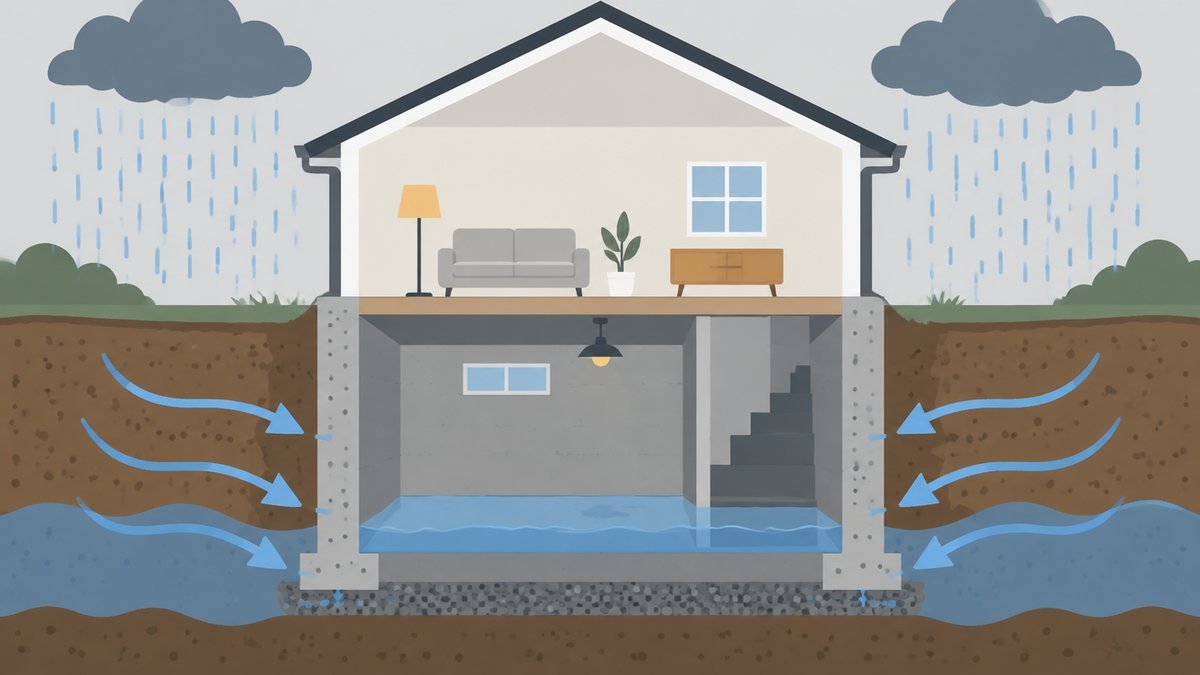
A wet basement almost always starts outside the house. Rain and melting snow soak the soil around the foundation, and that water looks for the easiest way in: through the sump, up the sewer line, through cracks in the walls and floor, or through windows and doors. Fixing the way water behaves outside the wall is usually cheaper and more lasting than anything done inside it.
Not every damp basement is leaking, though. Warm, humid air can condense on cool concrete and look exactly like a seep. Sorting out which problem you have is the first step, and it decides which fix makes sense.
The four ways water gets in
The Federal Emergency Management Agency (FEMA) lists four routes into a basement. Knowing which one applies narrows the search quickly.
| Route | What it looks like | Usual cause |
|---|---|---|
| Through the sump (drainage system) | Water rises in the pit or overflows during heavy rain | Saturated soil sends groundwater to the sump, or the pump fails or is overwhelmed |
| Up through sewer lines | Water or sewage backs up at a floor drain | Overloaded sewer lines under or near the house |
| Through cracks in walls and floor | Seepage or a damp line after rain | Water pressing against the foundation from saturated soil |
| Through windows and doors (overland flooding) | Water at window wells, stairwells or door thresholds | Surface water, low grade or failing weatherstripping |
All four are driven by the same thing: too much water in the ground next to the house, or water that has nowhere to go.
Where the water comes from
A state university extension service groups household moisture into use, maintenance and construction sources. For wet basements the last two matter most. Its summary is blunt: a builder who did a good job leaves a basement or crawl space that stays dry even at extra wet times of year, such as spring snowmelt. When a basement is wet, something about the site or the structure is not shedding water the way it should.
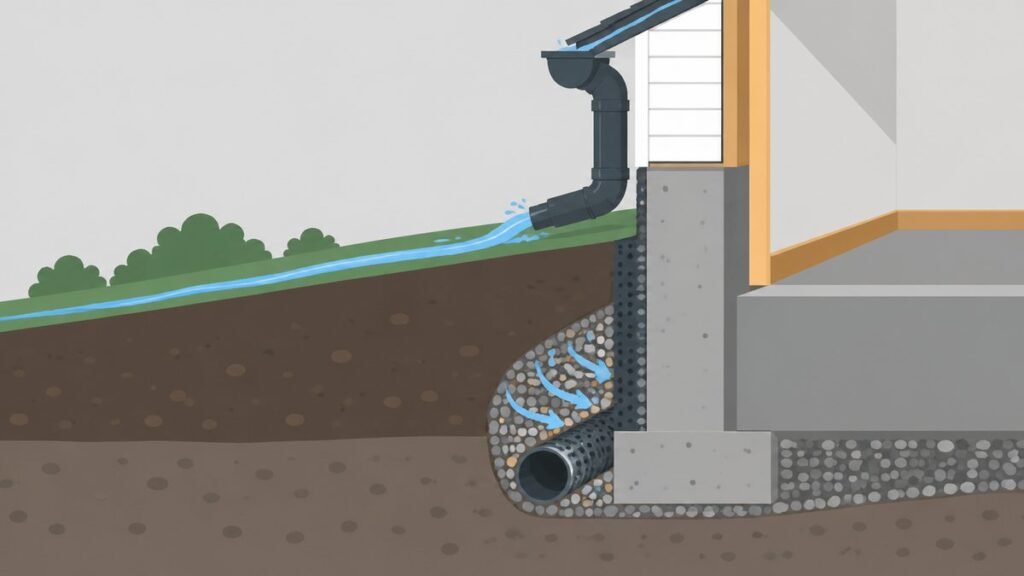
Maintenance problems are the easiest to fix. Clogged or disconnected gutters, downspouts that dump water beside the wall and soil that has settled toward the house all send roof and yard water straight to the foundation. The U.S. Department of Energy’s Building America Solution Center describes good water management as a package: grade sloping away from the house, gutters, a perimeter drain pipe, free-draining soil or a drainage mat, and a capillary break at the footing. If one piece is missing, the others work harder.
Condensation or a leak?
Before spending money, check whether the moisture comes from outside the wall or from the air in the room. A national laboratory paper describes a simple “polyethylene test.” Tape a clear plastic sheet about 2 feet by 2 feet to the suspect wall or floor with duct tape and leave it for two or three days.
- Damp spots on the side of the plastic against the wall mean moisture is moving through the concrete.
- Beads of water on the room side of the plastic mean the moisture comes from the air inside the building.
The test is a screening step, not a diagnosis, but it keeps you from waterproofing a wall that only needed less humidity. The U.S. Environmental Protection Agency (EPA) advises keeping indoor relative humidity under 60 percent, with 30 to 50 percent as the ideal range, and says a $10 to $50 humidity meter is enough to measure it. The extension service gives 35 to 55 percent as a target for cold climates. A dehumidifier helps with condensation, and our guide to basement humidity explains how much is too much.
Fix the outside first
Water control works best in a fixed order. Start with what is cheapest and works on every route at once.
- Grade. Slope the ground away from the house on all sides. The Building America Solution Center specifies at least 0.5 inch of drop per foot for the first 10 feet. Where less than 10 feet is available, it calls for swales or drains that carry water away.
- Gutters and downspouts. Keep them clear and connected, and make sure downspouts discharge at least 5 feet from the foundation, or into an underground catchment system located at least 10 feet away. The extension service recommends inspecting gutters and downspouts every year and cleaning them periodically.
- Window wells and doors. Clear debris from window wells, check that they drain and fit covers. FEMA notes that sturdy window well covers are widely available and simple to install.
- Drainage. If grading and gutters are fixed and water still gets in, the next step is drainage: a footing drain, a sump pit and pump, or both.
Do not skip to the interior. The Building America guide on sealing basement floors is explicit that sealing cracks and painting the slab with epoxy cannot stop dampness that comes from bad grading, missing gutters or a high water table. Treat the site first.
What the sump is doing
A sump pit sits at the lowest point of the floor and collects water from the footing drain. A sump pump moves it out to a storm sewer, if the local municipality permits that, or to a dry well away from the foundation. Discharging next to the house only recycles the same water. The pit also needs a gasketed, airtight cover, because an open pit lets soil gases such as radon, water vapor and others into the house.
FEMA points out that a pump can fail you in three ways: it breaks, the power goes out, or a downpour simply outruns it. A battery backup pump, FEMA says, is an inexpensive safeguard. For sewer backups, check valves or backflow valves keep water from flowing back into the basement, though homeowners should check with their local officials about whether the community permits them.
Signs to look for
A federal housing inspection guide lists a wet basement among the most frequent problems in small homes. Its inspection guide names the clues: damp surfaces, stains, peeling paint, efflorescence and rusting metal. Efflorescence is the white, powdery crust left when water carries salts through masonry and evaporates, so it marks the path moisture has taken.
Walk the basement after a heavy rain and note where water appears. Take photos with the date. A pattern, such as water always at the same corner or under the same downspout, is the most useful clue you can give a contractor.
Drying and mold
Wet materials need attention quickly. The EPA says water-damaged areas and items should be dried within 24 to 48 hours to prevent mold growth. For mold, the EPA says a patch smaller than about 10 square feet (roughly 3 feet by 3 feet) can in most cases be handled by the homeowner, while larger areas or a lot of water damage call for professional guidance.
When to call a professional
Most causes above are homeowner jobs: clearing gutters, extending downspouts, regrading with soil and testing humidity. Call a professional when:
- Water keeps coming in after grading and gutters are fixed.
- The water is deep, rising fast, or could include sewage.
- You see cracks that are wide, growing or horizontal, or walls that bow inward. Those are structural questions for a licensed engineer, covered in our guide to foundation cracks.
- Mold covers more than about 10 square feet.
- Electrical equipment is in or near the water.
The short version
- Find out whether it is condensation or a leak with the plastic-sheet test.
- Fix grading, gutters and downspouts first, then window wells.
- Add drainage, a sump and a backup pump if water still gets in.
- Dry everything within 24 to 48 hours and watch for mold.
- Call a professional for structural cracks, deep water, sewage or large mold areas.
Frequently asked questions
Why is my basement wet when it has not rained?
Condensation is a common cause. Warm, humid air condenses on cool concrete and looks like a leak. A plastic sheet taped to the wall for two or three days shows whether moisture comes from the wall or the room air.
What is the most common cause of a wet basement?
Water collecting next to the foundation, usually because the ground slopes toward the house or gutters and downspouts are clogged or empty beside the wall. These are also the cheapest causes to fix.
How far should downspouts discharge from the house?
The Building America Solution Center says at least 5 feet from the foundation, or into an underground catchment system located at least 10 feet away.
Will sealing the walls or floor stop basement water?
Not by itself. Sealers and epoxy paint do not prevent dampness if poor grading, missing gutters or a high water table is causing the water. Fix outside water control first.
How soon do I need to dry a wet basement?
The EPA says water-damaged areas and items should be dried within 24 to 48 hours to prevent mold growth.
Sources
The routes, distances and humidity figures in this guide come from the sources below. Local codes and soil conditions vary, so confirm anything structural with a licensed professional.
- Reducing Flood Risk to Residential Buildings That Cannot Be Elevated: Basement Flood Mitigation | FEMA
- Keeping Your Home Dry: How Water Enters Your Home | NC State Extension Healthy Homes
- Final Grade Slopes Away from Foundation | Building America Solution Center (U.S. Department of Energy)
- Gutters and Downspouts | Building America Solution Center (U.S. Department of Energy)
- Water Management of Existing Basement Floor | Building America Solution Center (U.S. Department of Energy)
- Drain or Sump Pump Installed in Basements or Crawlspaces | Building America Solution Center (U.S. Department of Energy)
- Case Studies of Moisture Problems in Buildings (Proskiw) | a national laboratory
- A Brief Guide to Mold, Moisture and Your Home | U.S. Environmental Protection Agency
- Residential Inspection, The Rehab Guide | U.S. Department of Housing and Urban Development