Choose how damp the space feels and enter its floor area to get the capacity range ENERGY STAR gives for a portable dehumidifier, in pints of water per day.
How dehumidifier size is chosen
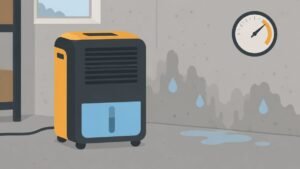
ENERGY STAR measures dehumidifier size, or capacity, in pints of water removed per 24 hours. It says the capacity you need depends on two things: the size of the space and its conditions without dehumidification. It also advises that it is better to oversize than undersize. Its chart for portable units, by relative humidity and room size:
| Condition without a dehumidifier | Space 2,000 sq ft or less | Space over 2,000 sq ft |
|---|---|---|
| Slightly to moderately damp, 50 to 75% humidity | 20 to 30 pints per day | 30 or more |
| Very damp, 75 to 90% | 25 to 40 | 40 or more |
| Wet, 90 to 100%, sweating walls or seepage | 30 to 50 | 50 or more |
There is no square-footage formula in the sources, so the tool does not make one up. It reads the chart for you.
Water per day (gallons) = capacity in pints ÷ 8
Worked example
A 1,200 sq ft basement feels damp all the time with damp spots on the walls
The condition is very damp, 75 to 90% relative humidity, and the space is under 2,000 sq ft.
ENERGY STAR gives 25 to 40 pints per day. That is 3.1 to 5 gallons of water a day.
ENERGY STAR says to lean toward the larger unit, and to fix any seepage first.
Why ratings changed in 2020
The Department of Energy changed the test for portable dehumidifiers so that they are tested at 65 degrees Fahrenheit instead of 80, to reflect a basement. There is less water to remove in cooler air, so the capacity ratings dropped, and ENERGY STAR publishes a rough conversion that the other two tabs use:
| Old portable rating | New approximate | Old whole-home rating | New approximate |
|---|---|---|---|
| 30 | 20 | 80 | 70 |
| 40 | 25 | 100 | 85 |
| 50 | 30 | 120 | 100 |
| 55 | 30 to 35 | 140 | 115 |
| 60 | 35 | 160 | 135 |
| 70 | 40 to 45 | 200 | 170 |
| 90 | 55 |
ENERGY STAR notes that the real change varies by model. The ranges in the first table are written in the new ratings.
What the tool does not cover
It does not size a whole-home dehumidifier, which a professional does, and it does not account for a very cold basement. ENERGY STAR advises a model made for low temperatures if the space often falls below 65 degrees Fahrenheit, because frost can form on the coils. It also does not replace fixing leaks, grading and gutters, which ENERGY STAR lists among the ways to reduce humidity.
Frequently asked questions
What size dehumidifier do I need for a basement?
ENERGY STAR gives 20 to 30 pints per day for a slightly to moderately damp space under 2,000 square feet, 25 to 40 for very damp and 30 to 50 for wet. Spaces over 2,000 square feet need 30, 40 or 50 pints or more.
Is it better to oversize a dehumidifier?
ENERGY STAR says it is better to oversize than undersize. A certified unit has a humidistat that cycles it on and off to hold the humidity you set.
Why do new dehumidifiers have lower pint ratings?
The Department of Energy changed the test in 2019 so portable units are tested at 65 degrees Fahrenheit instead of 80. Cooler air holds less water, so an old 50-pint unit is roughly a new 30-pint one.
What humidity should I set a basement dehumidifier to?
ENERGY STAR calls 30 to 50 percent relative humidity the optimum for a building and suggests 30 to 40 percent in cold weather. The EPA says to keep humidity below 60 percent.
Related guides
- What size dehumidifier you need
- Basement dehumidifier sizing and settings
- Dehumidifier drain options
- Ideal basement humidity level
- Basement humidity
Sources
The capacity ranges and the rating conversion come from ENERGY STAR, and the humidity targets from ENERGY STAR and the EPA.